For decades, solar panels converted sunlight into electricity with steadily improving results. Today, homeowners can generate more power from the same rooftop area. So, why are solar panels becoming more efficient? The answer involves better materials, smarter cell designs, improved manufacturing, and stronger testing standards. Tiny details matter.
Modern photovoltaic cells lose less energy through electrical resistance and surface reflection. Passivated emitter and rear cell technology helps capture light that older designs wasted. Tandem perovskite-silicon cells may absorb different parts of sunlight, although long-term durability remains uncertain. Manufacturing equipment has also become more precise. Thinner wires, cleaner silicon, and improved coatings can increase output without dramatically expanding panel size. In practical installations, temperature, shading, and roof direction still influence results. A panel is not magic.
Laboratory records often show impressive efficiency gains, but real roofs are less controlled. Dust, partial shade, high temperatures, and aging can reduce daily production. Even a high-efficiency panel may perform poorly when installed on a shaded roof. Manufacturers should therefore support their claims with independent testing, transparent warranties, and measurable field data. Claims should be questioned.
This guide examines the engineering changes behind modern solar panels and explains how they affect ordinary electricity generation. It will compare laboratory performance with real-world results, including seasonal weather and rooftop limitations. Some improvements are genuinely significant. Others may sound better than they perform. That uncertainty matters. Understanding the evidence helps buyers, installers, and energy planners choose technology based on dependable performance rather than marketing language.
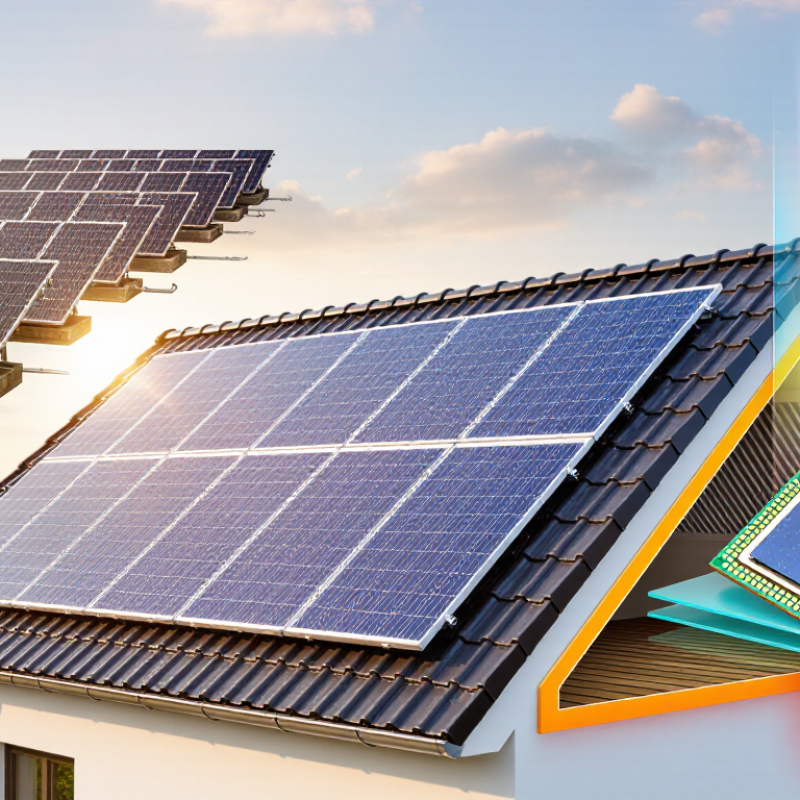
Commercial solar modules have improved sharply since 2010. NREL’s 2024 Photovoltaic Efficiency Chart tracks typical commercial module efficiency rising from about 15% to nearly 23%. That change means more electricity from the same rooftop area. A 20-square-metre roof can now produce noticeably more power without expanding its footprint.
Several engineering advances explain the progress. Passivated contacts reduce electrical losses at the cell surface. Better silicon wafers capture more light. Multi-busbar designs also lower resistance and improve current collection. The International Technology Roadmap for Photovoltaic, 2024 edition, reports continued gains in cell efficiency, thinner wafers, and lower material use across mainstream manufacturing. These improvements are measured under controlled test conditions, not every rooftop.
Real-world output remains less tidy. Dust, heat, shading, wiring losses, and imperfect installation reduce annual energy. Temperature matters. Module ratings commonly use 25°C laboratory conditions, while outdoor surfaces can become much hotter. NREL’s performance research shows that heat and system design strongly affect delivered electricity. The 23% figure is valuable, but it is not a promise for every project. I would also question simple year-to-year comparisons because testing methods and product mixes change. Efficiency improved; measurement is still imperfect.
Why Are Solar Panels Becoming More Efficient?
TOPCon and HJT silicon cells have pushed certified conversion efficiency beyond 26%. Their progress comes from reducing losses inside the cell. TOPCon adds an ultra-thin, passivating layer behind the silicon wafer. This layer limits electron recombination while allowing current to pass through carefully designed contacts. More sunlight becomes usable electricity.
HJT cells combine crystalline silicon with thin amorphous silicon layers. These layers improve surface passivation on both sides. They also support strong performance in hot conditions. During field testing, temperature matters greatly. A panel that performs well in a laboratory may produce less power on a summer roof. HJT can reduce this gap through a favorable temperature coefficient.
The details are not perfect. TOPCon manufacturing requires precise layer control and stable high-temperature processing. HJT production uses more specialized equipment and may face higher material costs. Efficiency also depends on wafer quality, shading, wiring, and installation angle. A 26% cell does not guarantee a 26% system. Real rooftops are messier.
Small gains still matter. On a limited roof, higher efficiency can create more usable capacity without adding extra panels. Better passivation may also support long-term output, although degradation depends on climate and construction quality. I would not judge a module by its headline number alone. Measurement standards, operating temperature, warranty terms, and independent testing deserve equal attention.
The chart compares selected, rounded research-cell efficiency milestones for major crystalline-silicon technologies. TOPCon and HJT exceed 26% by reducing electrical losses through improved surface passivation and more selective carrier transport.
Values are representative record-level research-cell efficiencies reported in photovoltaic literature and rounded to one decimal place. They are not average commercial module efficiencies.
Solar modules are becoming more efficient through better cell designs, improved light capture, and stronger system controls. Bifacial modules add another useful feature: they collect sunlight from both sides. The front surface receives direct sunlight, while the rear surface captures reflected and scattered light. This additional energy can increase annual yield by roughly 5–20% in suitable conditions.
The result depends heavily on the installation site. A bright roof membrane can reflect more light toward the rear cells. Pale gravel, snow, and light-colored ground can also improve rear-side exposure. Dark asphalt performs poorly. That difference matters. Module height, row spacing, and tilt angle influence how much light reaches the back. In my experience, cramped layouts often waste this advantage through shading and weak airflow.
Reliable estimates require more than a calculator. Engineers should compare measured irradiance, operating temperature, and inverter data after commissioning. Dust on the rear surface may reduce output, especially where wind carries soil beneath elevated arrays. Some projections also appear too optimistic because they assume ideal ground reflectivity. Real projects rarely behave perfectly. A careful design therefore includes site measurements, seasonal simulations, and a realistic allowance for soiling, shading, and gradual degradation.
Solar panels are improving through small engineering gains, not one dramatic invention. The 2024 International Technology Roadmap for Photovoltaic reports that mainstream silicon wafers increasingly use 182–210 millimetre formats. Larger wafers create more active area and reduce unused space between cells. They can also deliver more watts with fewer cells and electrical connections.
That matters because every connection adds resistance. Current loses energy as heat while passing through metal fingers, ribbons, and junctions. Modern production uses finer metallization, improved passivation, and multi-wire interconnections to shorten electrical paths. The Fraunhofer Institute’s Photovoltaics Report shows that commercial silicon modules now commonly exceed 20% efficiency, reflecting these combined manufacturing improvements.
The details are physical. A wafer leaves the furnace with a smoother surface. A better coating helps keep light-generated electrons from recombining. More precise screen printing reduces contact resistance without covering too much silicon. Small gains accumulate.
But larger wafers are not automatically better.
They carry higher current, which can increase resistive losses and mechanical stress. Manufacturing must control breakage, alignment, and temperature variation. The 2024 ITRPV report also indicates that thinner wafers remain an industry goal, although they demand tighter handling. This is where factory experience matters. A promising design can underperform when production tolerances drift. The improvement is real, but not effortless.
Why Are Solar Panels Becoming More Efficient?
Why 33.9% Perovskite–Silicon Tandems Set a New Efficiency Benchmark
Solar technology is improving because researchers are stacking different light-absorbing materials. Silicon captures much of the visible spectrum. Perovskite layers can absorb additional wavelengths more effectively. Together, they reduce some energy losses inside a solar cell.
The 33.9% result is important, but it needs careful interpretation. The National Renewable Energy Laboratory’s Best Research-Cell Efficiencies chart lists this certified perovskite–silicon tandem result among the leading research achievements. It is a laboratory cell, not a complete rooftop panel. The IEA Photovoltaic Power Systems Programme also reports that commercial module efficiency remains considerably lower than leading laboratory records. That gap reflects manufacturing limits, temperature changes, shading, and long-term reliability concerns. The number is impressive. It is not the whole story.
Tips: Compare cell efficiency with module efficiency. Check certification, operating temperature, warranty terms, and degradation data. Ask whether the figure comes from a stable, independently tested device.
Perovskite materials may lower production temperatures and use thinner semiconductor layers. However, moisture, heat, and ultraviolet exposure can still damage performance. Researchers are testing protective coatings and improved interfaces. Some results look promising, though outdoor evidence remains limited. I would treat 33.9% as a strong benchmark, not a guaranteed household outcome. The next challenge is making that efficiency durable, affordable, and repeatable across large areas.
| Data Dimension | Conventional Silicon Cell | Single-Junction Perovskite Cell | Perovskite–Silicon Tandem | Why It Matters |
|---|---|---|---|---|
| Highest widely reported research-cell efficiency | About 27.1% | About 26.1% | 33.9% certified benchmark | The tandem uses two light-absorbing materials to convert a wider portion of the solar spectrum than either single-junction cell. |
| Cell architecture | Single junction | Single junction | Two-terminal tandem | A two-terminal design places a wide-bandgap perovskite sub-cell above a lower-bandgap silicon sub-cell, allowing both sub-cells to work together. |
| Approximate absorber bandgap | 1.12 eV | Approximately 1.6–1.8 eV, depending on composition | Approximately 1.7 eV perovskite over 1.12 eV silicon | The upper cell absorbs higher-energy visible light while lower-energy near-infrared light passes to the silicon cell. |
| Theoretical efficiency potential under idealized conditions | Approximately 29.4% for an ideal silicon single junction | Approximately 33% for an ideal single junction near its optimum bandgap | Above 40% in ideal tandem-limit calculations | Sharing the solar spectrum between two optimized bandgaps reduces thermalization and transmission losses. |
| Main source of efficiency gain | Strong performance in the near-infrared range | Adjustable bandgap and strong visible-light absorption | More complete spectral utilization | Photons that would lose excess energy as heat in silicon can be absorbed more efficiently by the higher-bandgap top cell. |
| Typical top-cell thickness | Silicon wafer is typically about 100–200 micrometres in laboratory and commercial formats | Usually less than 1 micrometre for the active absorber layer | Thin perovskite top layer on a silicon bottom cell | The perovskite layer requires very little material and can be deposited on an established silicon platform. |
| Light-management advantage | One absorber must handle most usable sunlight | Efficient visible-light absorption but limited infrared response at its usual bandgap | Front cell filters and shares sunlight with the rear cell | Optical and electrical design can reduce losses caused by reflection, incomplete absorption and excess photon energy. |
| Key technical challenge | Approaching the single-junction efficiency ceiling | Long-term stability, moisture sensitivity and scale-up | Stable interfaces, reliable encapsulation, current matching and manufacturing uniformity | Laboratory efficiency must be maintained over large areas and long operating lifetimes before widespread deployment. |
| Meaning of the 33.9% result | Not applicable | Not applicable | A certified laboratory-cell result, not a typical commercial-module rating | Research-cell records demonstrate technical potential; module efficiency and lifetime are separate performance measures. |
| Expected system-level benefit | Established manufacturing and durable field performance | Potentially low material use and tunable optical properties | More electricity from the same area | Higher conversion efficiency can be especially valuable where roof, land, mounting or installation area is limited. |
| Data notes and sources: Efficiency values refer to independently reported research-cell records and rounded historical benchmarks. The 33.9% value is a certified perovskite–silicon tandem-cell benchmark. Theoretical-limit values are idealized calculations and should not be compared directly with commercial-module ratings. Reference sources include the National Renewable Energy Laboratory Best Research-Cell Efficiencies chart and the Progress in Photovoltaics efficiency tables. | ||||
Typical efficiency rose from about 15% to nearly 23% by 2024. That is a substantial gain.
A 20-square-metre roof can produce more electricity without adding space. More power, same footprint.
Passivated contacts reduce surface losses. Better silicon wafers capture more light. Multi-busbar designs improve current collection.
Dust, heat, shading, wiring losses, and poor installation reduce annual output. Real rooftops are messy.
No. Ratings commonly use 25°C laboratory conditions, while rooftop surfaces may become much hotter.
TOPCon uses an ultra-thin passivating layer behind the silicon wafer. It limits recombination and guides current through designed contacts.
HJT combines crystalline and amorphous silicon layers. These layers improve surface passivation and can support a better temperature response.
No. Wafer quality, shading, wiring, temperature, and installation angle also affect system output. The headline number is incomplete.
Not necessarily. Compare temperature performance, degradation, warranty terms, testing, and installation conditions. Simple comparisons can mislead.
Testing methods and product mixes can change. The trend is real, but the comparison is not perfectly clean.
Why are solar panels becoming more efficient? Between 2010 and 2024, commercial module efficiency rose from about 15% to 23%, driven by advances in cell design, materials, and manufacturing. Modern TOPCon and HJT silicon cells have exceeded 26% efficiency by reducing electrical losses and improving the movement of charges within the cell. At the module level, bifacial designs can capture light reflected from the ground and surrounding surfaces, increasing total energy yield by roughly 5–20% depending on installation conditions.
Larger wafers also help generate more electricity from each module while improved production methods reduce resistance, shading, and connection losses. The next major step is tandem technology, which combines perovskite and silicon layers to use a broader range of sunlight. With laboratory efficiencies reaching 33.9%, these tandem cells establish a new benchmark and show how continued innovation could make solar power more productive, affordable, and practical.

Halkirk Solar